Monday, January 30, 2017

Idaho Skies for February 2017

February 1 – 7
The solar system’s largest asteroid is Ceres and it’s quite easy to find on the night of the 2nd. To see it, point your binoculars at the moon and then look ½ degree straight down the moon’s terminator, or boundary between day and night. There will be two stars below the moon and Ceres is the star to the right and slightly closer to the moon. Ceres was the first asteroid discovered by astronomers (on January 1st, 1801 in fact) and it is 590 miles across. Right now, the Dawn spacecraft is orbiting this dwarf planet. Dawn discovered that Ceres is rich in water. Its surface has bright patches that are the result of a briny solution welling up to the surface. All that water means it would be a great place to put a refueling station for spacecraft sometime in the future.   


 The moon is at the first quarter phase on the 3rd. So if it’s warm that night, take your binoculars out and scan up and down the terminator of the moon. You’ll be delighted in the number of craters you’ll see through binoculars. This is especially true in the southern hemisphere of the moon.     

The first spacecraft to soft land on another world did so on February 3rd, 1966. The spacecraft’s named was Luna 9 and the Soviet space program launched it. The 218 pound spacecraft set down on the moon at a speed of 14 mph and was cushioned from the impact with a landing bag. Luna 9 transmitted a total of nine images from the moon. The funny thing however, is who the first people were to release the Luna 9 images to the world. British astronomers at the Jodrell Bank radio telescope detected transmissions from Luna 9 and realized that the signal had the same format of a fax machine. So they attached a fax machine to their radio telescope and were able to print images of the lunar surface before the Soviet Union scientists could release the images to the world. Ouch! That had to sting a little bit.  

You’ll find the first quarter moon between two nice star clusters on the 4th. The star clusters are the Pleiades and Hyades, which are very attractive in your binoculars. This means the moon’s presence makes this an excellent astronomical opportunity for your binoculars.


 The moon is 3 degrees away from the bright star Aldebaran on the 5th. Many stargazers know this is the brightest star in Taurus the Bull and that it has an orangish color. At an angular distance of three degrees, the moon is close enough to the Aldebaran and the Hyades star cluster to create an attractive vista in this part of the heavens.


Can you picture Orion batting a ball over his head? You should be able to on the night of the 6th. Why? Because that’s when the gibbous moon appears above the constellation. Be sure to spend a little time scanning the sword of Orion, or the two stars visible below the middle of his belt. The fuzzy cloud you’ll see is the Orion Nebula, a region of glowing dust and gas in which new stars are forming today.

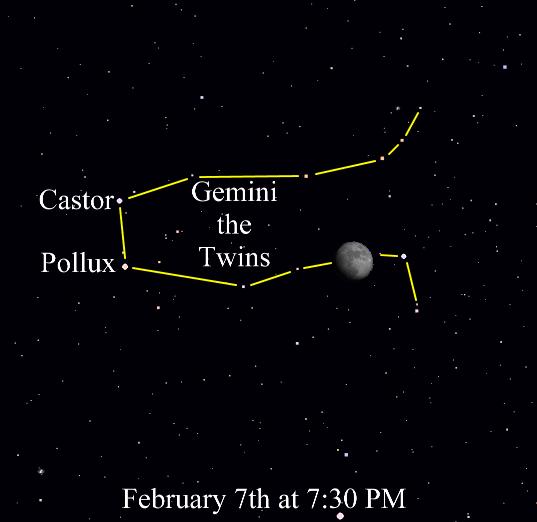
The moon passes through the feet of Gemini the Twins on the 7th. This makes the night of the 7th a great time to learn how to identify this constellation. The brightest star in Gemini is named Pollux and its slightly fainter twin is Castor. Pollux and Castor will appear on the left end of the two horizontal rows of stars.    


 February 8 – 14
The moon rises in a weak eclipse on the 10th. By weak eclipse, I mean a penumbral eclipse, or one in which the moon passes just though the outer rim of Earth’s shadow. It gets dark enough to see the eclipse by 7:00 PM and the eclipse ends at 7:30. Therefore, stargazers don’t have much time to observe this event. Binoculars will be helpful in seeing the subtle shading of Earth’s shadow on the upper portion of the moon.


 The penumbral eclipse also means the moon is full on the 10th. The full moon in February is often called the Snow Moon for obvious reasons. Looking at the full moon through binoculars is a blinding sight, but not in the literal sense. Enjoy.

There’s a bright star below and left of the moon on the 10th. Can you guess which one it is? Why it’s Regulus, the brightest star in Leo the Lion. Regulus, like Aldebaran, is a royal star. There are a total of four royal stars, Antares and Fomalhaut being the other two. The ancient Persians regarded these stars are guardians of their respective quadrants of the sky. One person responsible for bringing these stars and their function to our attention was the Persian prophet Zarathustra.


February 15 – 21
Jupiter appears as the bright star beneath the moon on the morning of the 15th. You’ll need to go outside just after midnight if you want to see Jupiter. However, since that’s a work day, you might prefer to get up a few minutes earlier on the morning of the 15th instead. The moon is nearly third quarter, meaning your binoculars will show craters along the terminator of the moon. And of course, Jupiter's four major satellites will be well placed for viewing. From Jupiter and going left, the satellites are Io, Europa, Callisto, and Ganymede.  


The moon’s at the last quarter phase on the 18th. That means anytime after midnight will be a good time to go moon viewing with your binoculars. Along the terminator will be a mass of visible craters, especially in the southern hemisphere. 


John Glenn became America’s newest hero on February 20th 1962. Glenn was the third Mercury astronaut launched and the first to orbit Earth (three times). Unlike Shepard and Grissom before him, an Atlas missile launched Glenn’s Mercury spacecraft into space. The more powerful Atlas gave his capsule the speed it needed to remain in Earth orbit. His mission lasted for five hours and showed that the United States knew how to send humans into space. Unfortunately, we lost this American hero last December at the age of 95.

Are you looking for Saturn? Then let the moon show you where to look for Saturn on the morning of the 20th. Saturn appears as the creamy yellow-white star to the lower left of the moon. You need a telescope or at least a spotting scope to see Saturn’s rings and largest satellite, Titan. If you have the time, scan the region left of Saturn for fuzzy star clusters and nebulae.


Beginning the 20th is a good time to start looking for earthshine as you drive to work. The crescent moon is visible in the low east. Earthshine will be the faint illumination on the moon’s upper right.  

February 22 – 31

Thirty years ago on the 23rd, a blue super giant star in the Large Magellanic Cloud collapsed. Actually, this collapse occurred 168,000 years earlier, but it took light from the explosion that long to reach our solar system. The collapse of a massive star is called a supernova and this one was named SN 1987A by astronomers. SN 1987A is the brightest and closest supernova since the invention of the telescope over 400 years ago. It‘s still the best opportunity astronomers have to study the supernova process and its after effects. In fact, it turns out that neutrino detectors on Earth detected a burst of 25 neutrinos from the explosion some three hours earlier. The neutrinos, which are subatomic particles that rarely interact with matter, were able to escape the collapse and reach Earth hours earlier. This detection of neutrinos on Earth was the beginning of neutron astronomy. Now, astronomers know that a burst of neutrinos from space are the sign of an impending supernova explosion.   

The moon is new on the morning of the 26th. So don’t expect to see the moon again until the 28th.

After dark on the 26th, look in the low west for brilliant Venus. Most stargazers will know that Mars is the dimmer yellowish-orange star to the upper left of Venus. However, did you know the planet Uranus is there also? To see Uranus, aim your binoculars first at Mars. Uranus is the star ½ of a degree to the lower left of Mars. That means Uranus is about 1/15th the distance across your binocular’s field of view. Uranus is brighter than any star that close to Mars, so you can’t miss it.  


When the moon becomes visible again on the 28th, it will be in the presence of Venus and a comet. The comet’s name is Encke and it orbits the sun once every three years and four months. The comet is not known for being spectacular, but could very well be visible in binoculars. To find it, aim your binoculars at Venus, the brightest star in the low west. Then scan six degrees below Venus, or most of the field of view of your binoculars. You’re looking for a hazy spot with a possible extension upwards. 


This Month’s Sources

Astronomical Phenomena of the Year 2017, The Nautical Almanac Office and Her Majesty’s Nautical Almanac Office
Astronomy Calendar of Celestial Events for Calendar Year 2017, http://www.seasky.org/astronomy/astronomy-calender-2016.html
Luna 9, https://en.wikipedia.org/wiki/Luna_9

Night Sky Explorer

Dark Skies and Bright Stars,

Your Interstellar Guide

February's Star is Sirius


This month look for the star Sirius. Sirius is the lucida of the constellation of Canis Major, the Big Dog and its half way up in the sky when you face towards the southwest during February nights. It’s the brightest star in the heavens and only the planets Venus, Mars, and Jupiter can surpass its nighttime brilliance. Sirius is a bright white star that appears to throw off sparks of color when it’s low to the horizon. That’s because there’s more atmosphere low in the horizon to refract its starlight. If you were born in 2006, then Sirius is your birthday star this year because the light you see tonight left Sirius 9 years ago. The name Sirius comes from the Greek word for scorching. During the Dog Days of summer, which occurs in early August, the sun and Sirius are close together in the sky. The Greeks believed that the heat of Sirius added to the sun’s heat, making these days especially hot.  

Sirius has a strange companion. Back in the early 19th century, astronomers discovered that the star wobbled back and forth as it slowly drifted across the sky. It was as if the gravity of a massive star was tugging on it. However, try as they might, no astronomer could discover a star close to Sirius to account for its wobbly motion. It wasn’t until 1854 when Alvan Clark turned a new 18 inch refracting telescope to the star that he discovered a tiny spark of a star next to Sirius. The star was not really that faint, but its closeness to Sirius made it impossible to see with previously telescopes.

The companion to Sirius, called the Pup Star, orbits Sirius with a period of fifty years. From the amount of tugging Sirius experiences from this star, we know that the Pup Star has a mass equal to our sun. What’s so surprising is that if we viewed the sun from nine light years away, we would easily see it with the unaided eye. However, the Pup Star isn’t. What gives?  Stars like the Pup Star have the spectrum of a very hot star. Therefore, every square foot of these stars is more intense than an equal area of our sun. The low total brightness but high surface intensity of these types of star tells astronomers that they must be very tiny, about the size of our planet. We call them White Dwarf stars.

Once each white dwarf was like our sun, moderately bright and moderately large. Once its nuclear fuel ran out, the star collapsed on itself because it could no longer support its weight using nuclear fusion. Only the repulsion between electrons keeps white dwarf stars from collapsing any smaller. The compression of a star into a white dwarf makes it incredibly dense. A billiard ball of white dwarf weighs as much as a tank, or about the same weight as 100 family cars.

Idaho Skies Transcript for February 3rd to 5th

RACHEL
Welcome to Idaho Skies for February 3rd, 4th, and 5th. We’re your hosts, Rachel...

PAUL
...and Paul.

RACHEL
The first spacecraft to soft land on another world did so on February 3rd, 1966.

PAUL
The spacecraft’s name was Luna 9 and it was launched by the Soviet Union.

RACHEL
The 218 pound spacecraft set down on the moon at a speed of 14 mph.

PAUL
To protect it from that landing speed, it was cushioned with a landing bag.

RACHEL
Luna 9 transmitted a total of nine images from the moon.

PAUL
The funny thing however, is who were the first people to publicly release the Luna 9 images to the world.

RACHEL
British astronomers at Jodrell Bank radio telescope were monitoring radio transmissions from Luna 9.

PAUL
From the sound of the signals, they realized the signal had the same format of a fax machine.

RACHEL
So the astronomers attached a fax machine to their radio telescope and printed images of the lunar surface.

PAUL
They released the images to the media before the Soviet Union.

RACHEL
Ouch! That had to sting a little bit.

PAUL
You’ll find the first quarter moon between two nice star clusters on the 4th.

RACHEL
The star clusters are the Pleiades and Hyades, both of which are very nice star clusters for your binoculars.

PAUL
This means the moon’s presence makes this an excellent astronomical opportunity for your binoculars.

RACHEL
That’s Idaho Skies for the 3rd, 4th, and 5th of February.

PAUL
Be sure to read our blog for additional information. It’s at idahoskies.blogspot.com.

For Idaho Skies this is Paul...

RACHEL
...and Rachel.

PAUL
Dark skies and bright stars.

Idaho Skies Transcript for February 1st and 2nd

PAUL
Welcome to Idaho Skies for February 1st and 2nd. We’re your hosts, Paul...

RACHEL
...and Rachel.

PAUL
The solar system’s largest asteroid is Ceres and it’s easy to find on the night of the 2nd.

RACHEL
To see Ceres, first point your binoculars at the moon.

PAUL
Then look ½ degree straight down the moon’s terminator, or boundary between day and night.

RACHEL
For a sense of scale, half a degree is the apparent diameter of the moon.

PAUL
Stargazers will see two stars directly below the moon.

RACHEL
And Ceres is the star to the right

PAUL
And the one that’s slightly closer to the moon.

RACHEL
Ceres was the first asteroid that astronomers discovered.

PAUL
In fact, they discovered on January 1st, 1801.

RACHEL
This dwarf planet is 590 miles across.

PAUL
Meaning it would span the distance across Idaho and Wyoming.

RACHEL
Did you know there’s a spacecraft in orbit around Ceres?

PAUL
Its name is Dawn and this is the second asteroid it has visited.

RACHEL
Dawn discovered the presence of bright spots on the surface of Ceres.

PAUL
The spots turned out to be salts deposited on the surface of Ceres.

RACHEL
Those salt patches were the result of a briny solution welling up to the surface.

PAUL
All that salt means that Ceres is rich in water.

RACHEL
And that will make it a great place to put a refueling station for spacecraft in the future.

PAUL
That’s Idaho Skies for the 1st and 2nd of February.

 RACHEL
Be sure to follow us on Twitter @IdahoSkies for this week’s event reminders and sky maps.

For Idaho Skies this is Rachel...

PAUL
...and Paul.

RACHEL
Dark skies and bright stars.

Idaho Skies Transcript for January 30th and 31st

RACHEL
Welcome to Idaho Skies for January 30th and 31st. We’re your hosts, Rachel...

PAUL
...and Paul.

RACHEL
The month ends with the moon pulling along side of Venus and Mars.

PAUL
So after dark on the 31st, look high in the southwest for the crescent moon.

RACHEL
Venus and the moon will appear side by side.

PAUL
And they make for a bright pairing in the western evening sky.

RACHEL
Alas, poor Mars only appears as a medium-bright yellowish-orange star.

PAUL
And it’s located above the right horn of the crescent moon.

RACHEL
Mars and Venus appear close together in the sky...

PAUL
...but they’re not close together in space.

RACHEL
Mars is located on the other side of the solar system...

PAUL
...while Venus is located on our side of the solar system.

RACHEL
That means Mars is nearly four times farther away from Earth and Venus.

PAUL
If you have a telescope, point it at Venus before the sky gets too dark.

RACHEL
Be sure to look before dark because the brilliance of Venus makes it difficult to see the planet’s phase after the sky gets dark.

PAUL
In a telescope, Venus will appear in the first quarter phase, or half full.

RACHEL
The fact that Venus passes through the full compliment of phases is evidence that Venus orbits the sun.

PAUL
Galileo understood this and used it as one of his evidences that the planets orbit the sun and not Earth.

RACHEL
We’ll have more to say about Galileo this month, since his birthday’s in February.

PAUL
That’s Idaho Skies for the 30th and 31st of January.

RACHEL
Be sure to read our blog at idahoskies.blogspot.com for additional information.

For Idaho Skies this is Rachel...

PAUL
...and Paul.

RACHEL
Dark skies and bright stars.

Monday, January 23, 2017

Transcript for January 27th, 28th, and 29th

PAUL
Welcome to Idaho Skies for January 27th, 28th, and 29th. We’re your hosts, Paul...

RACHEL
...and Rachel.

PAUL
The moon is new late on the 27th.

RACHEL
Unfortunately, the moon is not passing over the sun.

PAUL
That would result in a solar eclipse like the one Idahoans will see on August 21st.

RACHEL
Even though the moon is not passing over the sun, it’s still too close for stargazers to see.

PAUL
To be able to see the moon, it has to be far enough away from the sun to be above the horizon after the sun has set.

RACHEL
Depending on the tilt of the moon’s path with respect to the horizon...

PAUL
...and the speed of the moon around Earth...

RACHEL
...some stargazers have seen the moon when it was just under 24 hours old.

PAUL
In our case, we get an opportunity to see the moon on the 29th when its 48 hours old.

RACHEL
Your chance of seeing the moon that young is greater if you drive up to Bogus Basin.

PAUL
That way you’re above the haze in the valley.

RACHEL
And the horizon between west and southwest appears lower.

PAUL
It should get dark enough to see the moon by 6:30 PM.

RACHEL
But a pair of binoculars might show it 30 minutes earlier.

PAUL
However, do not start scanning the horizon with binoculars until after the sun has set.

RACHEL
If you see the moon on the 29th, you’ll have accomplished a feat very people have done.

PAUL
Now, can you beat your record and find the moon when it’s even younger?

RACHEL
It’s a game some stargazers like to play.

PAUL
That’s Idaho Skies for the 27th, 28th, and 29th of January.

RACHEL
Be sure to follow us on Twitter at Idaho Skies for this week’s event reminders and sky maps.

For Idaho Skies this is Rachel...

PAUL
...and Paul.

RACHEL
Dark skies and bright stars.

Transcript for January 25th and 26th

RACHEL
Welcome to Idaho Skies for January 25th and 26th. We’re your hosts, Rachel...

PAUL
...and Paul.

RACHEL
The Opportunity Mars rover celebrates its 12th year on Mars.

PAUL
Now this calls for a party.

RACHEL
Maybe a slice of Red Velvet cake?

PAUL
Perhaps.

RACHEL
Anyway, Opportunity was launched on July 7th 2003

PAUL
And designed for a 90 day mission on Mars.

RACHEL
However, JPL normally over-builds it spacecraft because of the harshness of spaceflight.

PAUL
Therefore, the rover has been traversing Mars for over 4,700 days so far.

RACHEL
Even though it travels more slowly than a human does...

PAUL
...yeah, 1/10th of a mile per hour...

RACHEL
...it has managed to cover over 27 miles of the Martian surface.

PAUL
This illustrates one of the benefits of using rovers in place of fixed spacecraft landers.

RACHEL
Opportunity has photographed dust devils crossing the surface.

PAUL
Which shows that Mars’ very thin atmosphere can push winds fast enough to lift small dust grains off the surface.

RACHEL
It’s also found the remains of old geothermal sites.

PAUL
We now know that Mars once had liquid water and magma interacting with each other like we see at Yellowstone.

RACHEL
It’s also discovered pristine meteorites laying on the Martian surface.

PAUL
That’s an indication that there’s too little liquid water on the surface of Mars today to chemical weather the meteorites.

RACHEL
So be sure to celebrate the anniversary of Opportunity’s landing on Mars.

PAUL
That’s Idaho Skies for the 25th and 26th of January.

RACHEL
Be sure to read our blog for additional information. It’s at idahoskies.blogspot.com.

For Idaho Skies this is Rachel...

PAUL
...and Paul.

RACHEL
Dark skies and bright stars.