Monday, August 29, 2016

September 1 – 7
Venus reappears as the Evening Star this month. You’ll find it very low in the west at 8:30 PM on the 1st. An additional treat is the very thin crescent moon on the 2nd. At just 1.5 days old, it may be difficult to detect in the still lukewarm evening sky. That means your binoculars will come in handy. For a final challenge, see if you can detect Jupiter. It appears as the only star to the right of both Venus and the moon. It’s much closer to the moon than Venus is to the moon, meaning Jupiter might help you locate the moon rather than the other way.

The moon reappears in the very low west on the evening of the 2nd. To see it, you’ll want to use your binoculars. First, find Venus, the brightest star in the low west at 8:30 PM. Then look slightly right of Venus through your binoculars to see the moon. The moon will be approximately 36 hours past new, which is younger than most people have seen the moon. You might even catch a glimpse of Jupiter on the moon’s right. This will be among your last chances to see the giant planet until October.

For the rest of the first week, keep your eye open for Earthshine. It appears as a faint illumination of the right side, or Eastern hemisphere of the moon. Binoculars make it easier to see. You can even make out some of the lunar maria on the dark side of the moon in Earthshine.

September 8 – 14

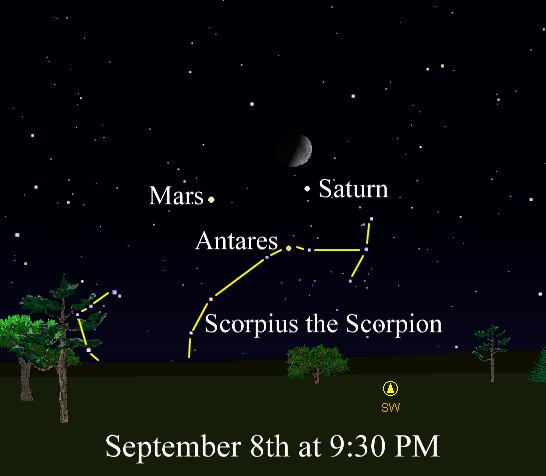
Saturn is the creamy white star below the moon on the evening of the 8th. The pair is less than 4 degrees apart and will therefore fit comfortably together in your binoculars. In a telescope, Saturn appears so serene. Below its exterior however, howl winds faster than 1,000 miles per hour. You’ll need a small telescope or even spotting scope to see the planet’s rings. In about seven years, those rings will turn edge on and become invisible in some telescope.  

The moon reaches first quarter phase on the evening of the 9th. First quarter phase is a great time to observe the moon in your binoculars or small telescope. With the boundary between day and night turned directly towards Earth, shadows cast by the rising sun will extend their greatest distance across the lunar surface from our perspective. That accentuates small changes in lunar elevation and helps to make the moon’s surface appear more jagged than it actually is. In reality, the lunar surface is for the most part, rounded and very dusty from the relentless bombardment of micrometeorites and cosmic rays.
 
Mars is the bright orangish star you’ll find to the lower left of the moon on the 9th. Their distance apart is too great to let both to be seen together in binoculars. Besides, Mars appears as just an orange star in binoculars.

Hey, you’ll find a teaspoon to the left of the moon on the 10th and a teapot below the moon. The teaspoon and teapot shaped pattern of stars are most of the constellation of Sagittarius the Archer. However, it’s easier to see a teaspoon and teapot with these stars than it is to see a Centaur and his bow and arrow.

The moon has company on the 14th. The region surrounding the moon is a watery part of the sky and the only bright star is Fomalhaut. Fomalhaut is the alpha star of the constellation of Pisces Austrinus, or the Southern Fish. Fomalhaut marks the mouth of the fish, which is swimming eastward. Above Pisces Austrinus is the constellation of Aquarius the Water Bearer. Aquarius is pouring water out of an opened jar and the fish below is swallowing it. At least that’s what the sky charts would have you believe.    

September 15 – 21
One planet the ancients did not see, but could have had they knew what they were looking for is Uranus. Uranus is an ice giant and the solar system’s 6th planet. Astronomer William Hershel discovered it telescopically over 230 year ago but can just reach naked eye visibility. As a result, it’s quite easy to see through binoculars. However, due to its faintness, it helps to when a brighter easy to find object is near by, as is the moon on the 18th.

On the 18th at 11 PM, place the moon at the bottom of your binoculars and you’ll see a star just to the left of the moon. Now go nearly straight up for a binoculars field of view to find a second star that’s the same brightness as the first. Make a turn to the right and you’ll see a line of three fainter stars in a line. The third star is Uranus. If you move your binoculars straight down, the moon will enter the view at the bottom just after Uranus leaves.    

The moon will also help you locate the constellation of Aries the Ram on the 18th. The Ram appears as three stars arranged in a slightly curving line. The constellation’s brightest star is named Hamal and it’s the star located in the east and to the moon’s upper left at 11:00 PM. The rest of the constellation consists of two stars further to the left of Hamal. There’s not much more to this constellation other than being able to say you can identify it when most other people can’t.

The moon forms a triangle with two bright and brash star clusters on the 20th. Look in the low east after 11:30 PM to see the Pleiades, or the Seven Sisters above the moon and the larger, but sparser Hyades to the lower left of the moon. The Hyades and Pleiades are classified as galactic star clusters. However, the Pleiades and Hyades are very different in appearance. The Pleiades will show a dipper-shaped pattern of stars in binoculars and you might see as many as two dozen member stars. The Hyades will fill your binoculars field of view with stars, but the stars will be further apart. A nicer contrast in star clusters can’t be had this side of the galaxy.

September 22 – 30
Orion is a winter constellation. This means you can see it in the later summer if you want to get up early in the morning. For those Early Birds up and about by 3:00 AM on the 22nd, look for Orion and the moon in the east. It really appears Orion has just hit a tennis ball. The tennis ball is the moon and Orion’s tennis racket is the arm above his head.

The Autumnal Equinox occurs on the morning of the 22nd. At that moment, Autumn begins in the Northern hemisphere. If you were to observe Earth and the sun from a distance, you’d notice that the orientation of Earth’s equator places it directly below the sun. For the next six month, the sun will be located directly over the Southern hemisphere. That leaves the Northern hemisphere with glancing sunlight and longer nights. As a result, it gets cold up here.

Are you looking for a small star cluster to see in your binoculars? Well, M-35 is just 6 degrees to the moon’s upper left on the morning of the 23rd. To see it, go outside at about 5:00 AM. Aim you binoculars at the moon and then shift your view to the upper left of the moon. Just after the moon leaves the field of view at the 4:00 o’clock angle, little M-35 will appear in the 10:00 o’clock angle.

Even if you have trouble finding M-35 on the 23rd, you’ll enjoy looking at the moon. That’s because the moon is in the third quarter phase, or half full. You’ll find lots of craters in the moon’s Southern hemisphere. You’ll find more and larger lunar maria in the moon’s Eastern hemisphere than you do in the Western hemisphere. The largest takes up most of the eastern edge of the moon and it’s called the Ocean of Storms.

Keep you eyes open for Earthshine after the 24th. As you drive on the 25th and after, you moon will appear in the low east. Its right side will appear faintly illuminated by sunlight reflected off Earth.

Mercury becomes a morning star from the 25th and until the end of month. Look for Mercury in the low east at about 6:30 AM. You can’t miss Mercury; it’s the first star you’ll see in the low east. In a few days, the moon joins Mercury.

On the morning of the 26th, the Beehive star cluster is visible 6.5 degrees to moon’s upper left. Even closer to the moon’s right is M-67, a smaller star cluster. Both star clusters belong to the constellation Cancer the Crab. To find the Beehive, point your binoculars at the moon and shift your gaze nearly straight up. Soon after the moon leaves, a tight bundle of stars will enter from the top. The star cluster M-67 is easier to find, but more difficult to see on account of its smaller size. Again point your binoculars at the moon, but this time, don’t move them. Just off the right edge of the moon will be M-67. It should appear as a small fuzzy spot.  

The very thin crescent moon picks up a companion star on the morning of the 27th. The star is named Regulus and it’s to the moon’s lower left. Regulus is the brightest star of Leo the Lion.

Look for Mars after it gets dark of the night of the 27th. Mars appears as an orangish star in the south-southwest. Above it are several of the brighter star clusters and nebulae in the constellation of Sagittarius the Archer. To see the star clusters and nebulae, aim your binoculars at Mars and shift your gaze upwards. Mars and the star clusters and nebulae will all fit within your binocular’s field of view.

Mercury reaches greatest western elongation on the 28th. You’ll see Mercury as the reasonable bright white star below the very thin crescent moon. You’ll need to look for it in the low east at 6:30 AM.

This Month’s Sources
Astronomical Phenomena of the Year 2016, The Nautical Almanac Office and Her Majesty’s Nautical Almanac Office
Astronomy Calendar of Celestial Events for Calendar Year 2016, http://www.seasky.org/astronomy/astronomy-calender-2016.html
Cassini, http://www.nasa.gov/mission_pages/cassini/whycassini/planet.html
Kochab and Pherkad, guardians of the north, http://earthsky.org/brightest-stars/kochab-and-pherkad-gaurd-the-north-celestial-pole
Night Sky Explorer

Dark Skies and Bright Stars,
Your Interstellar Guide

September's Stars are Kochab and Pherkad

This month look for two stars, Kochab and Pherkad. These stars are the called the Guardians of the Pole. Whom specifically are these stars guarding? Why it’s Polaris, the North Star. Kochab is the brightest of the pair and as bright as Polaris itself. Pherkad is one magnitude fainter and only 1/2.512 as bright. The pair is circumpolar in Idaho, like Polaris. That means they never set and never rise in our sky. The star pair is located on the opposite side of Ursa Minor, or what most casual stargazers call the Little Dipper. The stars of the Little Dipper located between the pair and Polaris are faint stars and require country skies to see.

Kochab is 130 light years away, meaning the light you see tonight left in the year 1886. Pherkad is over three times farther away at 480 light years. To be visible in our sky, they must be brighter, and therefore hotter, than our sun. Kochab is 500 times brighter than our sun and Pherkad is 1,100 times brighter.  

To find Kochab and Pherkad, find the Big Dipper and Polaris. Kochab and Pherkad are between them but not on a line with them. Kochab is the brighter and appears on the right side of the little dipper bowl and Pherkad is fainter and appears on the left side of the bowl.

Transcript: September 2 - 4

PAUL
Welcome to Idaho Skies for September 2nd, 3rd, and 4th. We’re your hosts, Paul...

RACHEL
...and Rachel.

PAUL
The 1.5 day old moon reappears very low in the west on the evening of the 2nd.

RACHEL
To find the moon, check around 8:30 PM, after sunset but before the sky is dark.

PAUL
The moon will be incredibly thin and easier to find if you locate Venus first.

RACHEL
Venus will appear as the brightest star very low in the west

PAUL
At just 1.5 days old, the moon may be difficult to detect in the still lukewarm evening sky.

RACHEL
No doubt, your binoculars will come in handy for seeing the tiny sliver of moon.

PAUL
There’s one more challenge, Jupiter.

RACHEL
The solar system’s largest planet is very close to the sun, from Earth’s perspective.

PAUL
As a result, casual stargazers lost sight of it two weeks ago.

RACHEL
With binoculars and the help of Venus, stargazers may still detect Jupiter.

PAUL
It appears as the only star located to the right of both Venus and the moon.

RACHEL
Jupiter is much closer to the moon than Venus is to the moon.

PAUL
Which means Jupiter might help you locate the moon rather than the other way around.

RACHEL
Even though Jupiter and the moon will look close, they are very far apart in space.

PAUL
The moon is 240,000 miles away

RACHEL
While Jupiter is 540 million miles away.

PAUL
That’s Idaho Skies for the 2nd, 3rd, and 4th of September.

RACHEL
Be sure to read our blog for additional information. It’s at idahoskies.blogspot.com.

For Idaho Skies this is Rachel...

PAUL
...and Paul.

RACHEL
Dark skies and bright stars.

New Format

The Idaho Skies radio show on Radio Boise is switching to a new format. Starting in August, we began creating shows for two or three days. The information you hear on Idaho Skies now is more relevant and less likely to be out of date.

Enjoy

Thursday, June 30, 2016

Transcript for July 24th to 30th

PAUL
Welcome to Idaho Skies for the fourth week of July. We’re your hosts, Paul...

RACHEL
...and Rachel.

PAUL
Last week you hear that the Blue moon was a second full moon within a month.

RACHEL
That’s the modern definition, but not the original.

PAUL
The original definition named the extra full moon within a season as the Blue Moon.

RACHEL
Typically, seasons have three full moons since there are three months in a season.

PAUL
According to the Old Farmer’s Almanac, the third full moon appearing in a season of four full moons is properly called the Blue Moon.

RACHEL
It was by accident that the Blue Moon got corrupted into the second full moon within a single month.

PAUL
Speaking of the moon, it will help you find Neptune on the 23rd.

RACHEL
The solar system’s 8th planet is always a challenge to locate and see.

PAUL
However, it will appear as a faint star three degrees to the moon’s right on the 23rd.

RACHEL
You’ll need a dark sky location to see it through your binoculars.

PAUL
To find Neptune, point your binoculars at the moon and then shift them to the right until the moon just leaves the field of view.

RACHEL
The brightest star now appearing nearly in dead center is Lambda Aquarii.

PAUL
This star is ˝ of a degree above Neptune, or the same width of the moon.

RACHEL
There is no other star directly below Lambda Aquarii except for Neptune.

PAUL
Meaning that if you see a very faint star below Lambda, you’re seeing Neptune.

RACHEL
The 7th planet is next to the moon after midnight on the 26th and it’s much easier to see than Neptune.

PAUL
On the 26th, Uranus is 4 degrees above the moon.

RACHEL
So to see Uranus, aim your binoculars at the moon and then shift them up until the moon at the bottom of your binocular’s field of view.

PAUL
You’ll see a narrow quadrilateral of four stars just above the center of the field of view.

RACHEL
Look above the quadrilateral for an even brighter star.

PAUL
The brighter star is Uranus.

RACHEL
There are star maps to help you locate both Neptune and Uranus on the Idaho Skies Twitter account.

PAUL
Early risers will discover that the moon forms a large triangle with two star clusters as they drive to work on the 28th.

RACHEL
The star clusters are named the Pleiades and the Hyades.

PAUL
Both star clusters are pleasing binocular objects.

RACHEL
And you’ll see around two dozen stars in each through your binoculars.

PAUL
Hey, the moon passes through the Hyades star cluster on the morning of the 29th.

RACHEL
Cool, the Hyades and moon will fill the field of view of your binoculars.

PAUL
The brightest star appearing above the moon is called Aldebaran.

RACHEL
Aldebaran is not a true member of the Hyades star cluster; it’s just a foreground star.

PAUL
That’s Idaho Skies for the fourth week of July. The thin crescent moon appears next to Jupiter next week.

RACHEL
Be sure to read our blog for additional information. It’s at idahoskies.blogspot.com.

For Idaho Skies this is Rachel...

PAUL
...and Paul.

RACHEL
Dark skies and bright stars.

Transcript for July 17th to 23rd

RACHEL
Welcome to Idaho Skies for the third week of July. We’re your hosts, Rachel...

PAUL
...and Paul.

RACHEL
The nearly full moon is surrounded by star clusters and nebulae on the 17th.

PAUL
Many of them are visible in binoculars as fuzzy spots and small knots of stars.

RACHEL
The star clusters and nebulae are located in the thickest part of the Milky Way.

PAUL
And that means it’s towards the center of our galaxy.

RACHEL
To see these star clusters and nebulae, scan the sky around the moon with binoculars.

PAUL
Remember that it’s easier to see the star clusters and nebulae if you move the moon out of your binocular’s field of view.

RACHEL
Why are these nebulae glowing with their own light?

PAUL
Well, there are two reasons nebulae glow.

RACHEL
The one case, some nebulae are located next to bright stars.

PAUL
The starlight reflects off of the dust filling the nebulae.

RACHEL
In long duration photographs, these nebulae are bluish-white in color.

PAUL
Astronomers call these nebulae reflection nebulae.

RACHEL
And the other kind of nebulae?

PAUL
Young and very hot stars are embedded in these kinds of nebulae.

RACHEL
Since the stars are hot, they emit lots of ultraviolet radiation.

PAUL
The ultraviolet makes the low pressure gas inside the nebulae glow like a fluorescent light or black light poster.

RACHEL
Astronomers call this emission nebula.

PAUL
And in astronomical photographs, these nebula appear red in color.

RACHEL
One of the most famous reflection nebulae is the glowing cloud of dust surrounding the Pleiades.

PAUL
Arguably, the most famous emission nebulae is the Orion Nebula.

RACHEL
Funny thing though, it appears green through an amateur telescope.

PAUL
Green? Why green?

RACHEL
There’s lots of red glowing hydrogen inside the Orion nebula, but our eyes are not very sensitive to red.

PAUL
The green comes from less abundant oxygen atoms that have lost two electrons.

RACHEL
Our eyes are much more sensitive to color green than to red.

PAUL
So even through there’s more hydrogen in the Orion Nebula, the green glow from oxygen overwhelms the red glow of hydrogen.

RACHEL
The moon is full on the 19th.

PAUL
The full moon in July is called the Thunder Moon.

RACHEL
Thunder moon? Why?

PAUL
Probably because in the eastern US, thunderstorms are more prevalent during this time of year.

RACHEL
Doesn’t each full moon have a name?

PAUL
Yes they do. Different cultures give the full moons different names.

RACHEL
So which moth has a full moon called the Blue Moon?

PAUL
None, really.

RACHEL
What?

PAUL
Yep. In one definition, the Blue Moon is the second full moon within any month.

RACHEL
There’s another definition?

PAUL
Yes there is, but we’re out of time.

RACHEL
So we’ll have to discuss this further next week.

PAUL
That’s Idaho Skies for the third week of July. See if you can find the outer planets next week.

RACHEL
Be sure to follow us on Twitter at Idaho Skies for this week’s event reminders and sky maps.

For Idaho Skies this is Rachel...

PAUL
...and Paul.

RACHEL
Dark skies and bright stars.

Transcript for July 10th to 16th

PAUL
Welcome to Idaho Skies for the second week of July. We’re your hosts, Paul...

RACHEL
...and Rachel.

PAUL
The brightest star of Virgo is located below the moon on the 11th.

RACHEL
Its name is Spica and it appears as a twinkling white spark of light in the low southwest.

PAUL
The reason stars twinkle and planets don’t is that planets have larger apparent surfaces than stars.

RACHEL
That’s right. Even though stars are much larger than planets, planets are tremendously closer to Earth.

PAUL
The planets’ closeness to Earth trumps the massively large size of stars and gives planets their larger apparent surfaces.

RACHEL
Because of their larger apparent surfaces, it takes more moving pockets of air to make planets twinkle.

PAUL
As a result, the normal movement of air makes star twinkle...

RACHEL
...but not planets.

PAUL
Unless of course, the air is very stormy.

RACHEL
Stars twinkle when moving pockets of air bend and refract their light.

PAUL
Each air pocket has a different temperature, density, and direction of movement.

RACHEL
So each air pocket behave like a prism with its unique optical property.

PAUL
So when a new pocket of air moves over a star, it refracts the position and colors of the star towards or away from your eye.

RACHEL
And that’s star twinkle in a nutshell.

PAUL
The star directly below the moon on the 13th is called Zubenelgenubi.

RACHEL
Zubenelgenubi is a famous double star, but one that many listeners may not have heard of before.

PAUL
The distance between Zubenelgenubi and the moon is 4 degrees...

RACHEL
...or small enough that you can see both the moon and Zubenelgenubi at the same time in a pair of binoculars.

PAUL
The distance between the two stars in Zubenelgenubi is wide enough that your binoculars can resolve the stars as individuals.

RACHEL
The real challenge is to see if you can resolve Zubenelgenubi as two stars with you’re your eyes.

PAUL
Some people can.

RACHEL
On the 15th, the ringed planet Saturn is the yellowish-white star located 2.5 degrees below the moon.

PAUL
While binoculars don’t reveal anything about the planet, a telescope of modest power is enough to let you can see its rings and largest satellite.

RACHEL
This means a spotting scope or small telescope is powerful enough.

PAUL
You’ll need a magnification of at least 25 times, however.

RACHEL
What about Titan, Saturn’s largest satellite?

PAUL
It appears as a star to Saturn’s upper right in a small telescope.

RACHEL
A spotting scope, which doesn’t flip images, will show Titan to Saturn’s lower left instead.

PAUL
In professional telescopes, Titan appears as a tiny orangish disk.

RACHEL
The orange comes from the thick clouds surrounding the satellite.

PAUL
Wait, Titan has an atmosphere of nitrogen and methane and those are colorless gases.

RACHEL
Well, solar ultraviolet acting on the methane gas in Titan’s atmosphere is converting the methane gas into more complex molecules.

PAUL
And those gases creates Titan’s pumpkin-colored clouds.

RACHEL
Astronomers call the orange compounds in Titan’s hazy atmosphere Tholins.

PAUL
And they just might be some of the precursors of life on Earth, 3.8 billion years ago.

RACHEL
That’s Idaho Skies for the second week of July. We’ll talk about great glowing clouds of gas next week.

PAUL
Be sure to read our blog for additional information. It’s at idahoskies.blogspot.com.

For Idaho Skies this is Paul...

RACHEL
...and Rachel.

PAUL
Dark skies and bright stars.