Monday, November 14, 2016

Transcript for November 16th to 17th

PAUL
Welcome to Idaho Skies for November 16th and 17th. We’re your hosts, Paul…

RACHEL
…and Rachel.

PAUL
An easy way to learn how to identify Gemini the Twins is to wait until the moon appears near it…

RACHEL
…which happens on the 16th this month.

PAUL
Stargazers will find the moon located between the feet of Gemini.

RACHEL
The rest of Gemini appears as a row of two stars…

PAUL
…and the rows appear to the left of the moon.

RACHEL
A good time for stargazers to look for Gemini is around 10:00 PM.

PAUL
Hey, what’s that bright star below the moon on the 17th?

RACHEL
Why it’s Procyon, the brightest star in Canis Minor, or the Little Dog.

PAUL
Canis Minor is one of Orion’s faithful hunting dogs.

RACHEL
Wow, Procyon is a very bright star.

PAUL
Yes, but it appears that way only because it’s one of the closest stars to the solar system and not because its one of the brightest stars in the galaxy.

RACHEL
Did you know that a nearly invisible companion star orbits Procyon?

PAUL
Yes I did. It’s nearly invisible because it’s a white dwarf.

RACHEL
White dwarf stars have intensely bright surfaces, but they’re only the size of Earth.

PAUL
So even though their surfaces are blindingly bright, they’re too small to generate a lot of light.

RACHEL
When the sun runs out of hydrogen fuel in five billion years, it too will become a white dwarf star.

PAUL
And its gravity will crush it down by a factor of 100.

RACHEL
Then a sugar cube sized piece of the sun will weigh as much as a car on Earth.

PAUL
That just goes to show that atoms are mostly empty space.

RACHEL
That’s Idaho Skies for the 16th and 17th of November.

PAUL
Be sure to follow us on Twitter at Idaho Skies for this week’s event reminders and sky maps.

For Idaho Skies this is Paul…

RACHEL
…and Rachel.

PAUL
Dark skies and bright stars.

Transcript for November 14 to 15

RACHEL
Welcome to Idaho Skies for November 14th and 15th. We’re your hosts, Rachel…

PAUL
…and Paul.

RACHEL
Stargazers will find the moon swimming through the Hyades star cluster on the 15th.

PAUL
This is a morning event, so look for it before you leave for work.

RACHEL
Aldebaran, a bright orange star in Hyades is just 3.5 degrees away from the moon.

PAUL
So your binoculars will show you the moon and Aldebaran at the same time.

RACHEL
The Hyades represent the face of Taurus the Bull…

PAUL
…and Aldebaran represents his eye.

RACHEL
Although it appears in the Hyades, Aldebaran is not a member of this star cluster.

PAUL
In fact, Aldebaran is only half as far away from the solar system as the star cluster.

RACHEL
When watched for many years, astronomers see that the apparent position of Aldebaran within the Hyades changes.

PAUL
That’s because Aldebaran and the Hyades have different proper motions.

RACHEL
Proper motion?

PAUL
Yes. It’s the apparent motion of a star across the sky.

RACHEL
And it’s the product of the motion of the star and the sun around the center of the galaxy.

PAUL
Proper motion is one tool that astronomers can use to determine which stars appearing within a star cluster actually belong to the star cluster.

RACHEL
As its getting dark on the 15th, look in the low west for Mercury.

PAUL
Mercury, Venus, and Mars will form a straight line spanning 45 degrees.

RACHEL
Remember that 45 degrees is one quarter of the way across the sky.

PAUL
The line begins in the southwest and tilts to the upper left.

RACHEL
And brilliant Venus is nearly dead center of the line.

PAUL
That’s Idaho Skies for the 14th and 15th of November.

RACHEL
Be sure to read our blog for additional information. It’s at idahoskies.blogspot.com

For Idaho Skies this is Rachel…

PAUL
…and Paul.

RACHEL
Dark skies and bright stars.

Monday, November 7, 2016

Transcript for November 11th to 13th

PAUL
Welcome to Idaho Skies for November 11th, 12th, and 13th. We’re your hosts, Paul…

RACHEL
…and Rachel.

PAUL
On the 13th, stargazers will find the moon passing close to the Pleiades star cluster.

RACHEL
The Pleiades are also called the Seven Sisters.

PAUL
The cluster appears as a small and bright star cluster on the moon’s left.

RACHEL
If you aim your binoculars at this star cluster, you’ll see around 24 member stars.

PAUL
Of course, a telescope with mirror or lens larger than two inches will show more member stars.

RACHEL
In binoculars and to the eye, the star cluster forms a tiny dipper shape.

PAUL
This confuses some people into thinking the Pleiades is the Little Dipper.

RACHEL
The star cluster is 444 light years away from the solar system.

PAUL
And astronomers believe it’s only 100 million years old.

RACHEL
That makes them only 1.5% as old as the solar system.

PAUL
Earth formed within 10 million years of the solar system’s origin, so we can expect stars in the Pleiades to have planets also.

RACHEL
Unfortunately, at 100 million years old, any planets in the Pleiades star cluster are still far from being able to support life.

PAUL
In fact, they are probably experiencing bombardment from the planetesimals still swarming in each nascent solar system.

RACHEL
What a sight the night sky would be however.

PAUL
The sky would be filled with lots of stars as bright as Sirius, the brightest star in Earth’s sky.

RACHEL
Perhaps our eyes would even be sensitive enough to see the dust and gas cloud wrapped around the stars of the Pleiades.

PAUL
It might be what it looks like when you’re inside a diamond.

RACHEL
That’s Idaho Skies for the 11th, 12th, and 13th of November.

PAUL
Be sure to follow us on Twitter at Idaho Skies for this week’s event reminders and sky maps.

For Idaho Skies this is Paul…

RACHEL
…and Rachel.

PAUL
Dark skies and bright stars.

Transcript for November 9th and 10th

RACHEL
Welcome to Idaho Skies for November 9th and 10th. We’re your hosts, Rachel…

PAUL
…and Paul.

RACHEL
Carl Sagan’s birthday is on the 9th.

PAUL
Sagan graduated from the University of Chicago with a PhD in astronomy in 1960.

RACHEL
In 1968, he moved to Cornell University and became a full professor in 1970.

PAUL
At Cornell, he worked at the Laboratory of Planetary Studies.

RACHEL
Sagan is also famous for his work promoting science and skepticism.

PAUL
He published books for the public like The Cosmic Connection, the Dragons of Eden, and Broca’s Brain.

RACHEL
However, he’s probably best known for his 1980 television series, Cosmos.

PAUL
At the time, it was the most expensive program created for public television and the most watched.

RACHEL
One of Sagan’s early astronomy successes was predicting that Venus had a hot and dry atmosphere based on the radio emissions of the planet.

PAUL
He cautioned the effects of increased carbon dioxide in Earth’s atmosphere could lead to a run away greenhouse effect like that affecting Venus.

RACHEL
Following the footstep of Harold Urey, Sagan began researching the effects of energy sources like lightening on primordial gases like nitrogen, hydrogen, and methane.

PAUL
The results were the creation of dark red liquids he called Tholins.

RACHEL
Astronomers and biologists believe that Tholins might be the precursors of life.

PAUL
And Tholins are believed to make Titan’s atmosphere orange-red.

RACHEL
Sadly, Carl Sagan died on December 20th, 1996.

PAUL
But a part of him lives on in the plaques and records launched onboard four spacecraft that escaped the solar system.

RACHEL
Perhaps in a billion years, an alien civilization will find Pioneer 10, Pioneer 11, Voyager 1, or Voyager 2 and learn about Earth.

PAUL
That’s Idaho Skies for the 9th and 10th of November.

RACHEL
Be sure to read our blog for additional information. It’s at idahoskies.blogspot.com.

For Idaho Skies this is Rachel…

PAUL
…and Paul.

RACHEL
Dark skies and bright stars.

Transcript for November 7th and 8th

PAUL
Welcome to Idaho Skies for November 7th and 8th. We’re your hosts, Paul…

RACHEL
…and Rachel.

PAUL
The moon reaches first quarter on the 7th.

RACHEL
At first quarter, the moon appears half full.

PAUL
This will be a fine time for stargazers to observe the moon through binoculars.

RACHEL
It’s shadows cast by the rising sun that makes lunar features visible through binoculars.

PAUL
And these shadows are most visible along the line delineating the boundary day and night.

RACHEL
Astronomers call the boundary between day and night the terminator.

PAUL
During the first quarter phase, the terminator is face-on to Earth…

RACHEL
…which means the shadows of sunrise are perpendicular to Earth.

PAUL
When they’re perpendicular, changes in elevations stand out with stronger relief…

RACHEL
…and that allows stargazers to see more craters and mountains.

PAUL
The Solitary One, a star named Fomalhaut is the only bright star below the moon on the 8th.

RACHEL
Fomalhaut really does stand out, doesn’t it?

PAUL
That’s because it’s the only bright star in a region occupied by faint stars.

RACHEL
This part of the night sky is called the Heavenly Waters.

PAUL
And it’s associated with the Mesopotamian god Ea who was a god of the waters, among other things.

RACHEL
The Sumerians placed most of the water-based constellations here.

PAUL
That includes constellations like Capricornus the Sea-goat, Pisces Austrinus the Southern Fish, Aquarius the Water-bearer, and Cetus the Whale.

RACHEL
That’s Idaho Skies for the 7th and 8th of November.

PAUL
Be sure to follow us on Twitter at Idaho Skies for this week’s event reminders and sky maps.

For Idaho Skies this is Paul…

RACHEL
…and Rachel.

PAUL
Dark skies and bright stars.

Wednesday, November 2, 2016

Alpheratz is November's Star


This month look for the star, Alpheratz, the lucida of Andromeda.  Alpheratz is one of only a few stars that connect two constellations together; in this case, Andromeda and Pegasus.  Alpheratz passes just south of the overhead position at 9:00 PM in early November and about two hours earlier in late November.  Alpheratz is 97 light years, so if you were born in 1919, Alpheratz is your birthday star this year. 

Alpheratz is classified as a “B” star, which is the second hottest class of star (only “O” is hotter).  The surface temperature of Alpheratz is approximately 13,000 degrees C, or about 23,000 degrees F. The total amount of radiation produced by the surface of Alpheratz is 200 times greater than our Sun.  To be a main sequence star that’s hotter than our Sun, Alpheratz must also be more massive than out Sun.  Therefore Alpheratz will live a shorter life than our Sun.

Alpheratz is our jumping off point to find the Andromeda Galaxy.  In dark skies you can see Andromeda Galaxy without optical aid.  In moderately lit skies, it can easily be found with a pair of binoculars.  Andromeda Galaxy has also been given the name of M-31.  Centuries ago, people had noticed the fuzzy looking star in the constellation of Andromeda.  Little did they know that it was a great island of over 100 billion stars, located some 2,500,000 light years away.


To find M-31, begin at Alpheratz.  The bottom three stars of Andromeda are her brightest and form a gentle arc.  The star closest to Alpheratz is not particularly bright, but the next star, Mirach, is.  Locate Mirach in your binoculars and put it in the lower right side of the binoculars (7X50’s) as illustrated below.  In the middle of the field of view will be the fainter Mu Andromedae and above that, Nu Andromedae will be close to the opposite edge of the binoculars.  Look next to Nu and note the fuzzy looking star.  This is the Andromeda Galaxy.  Once you have located it in binoculars, try locating it using just your eyes.  You’ll need reasonably dark skies to see M-31.

Idaho Skies Newsletter for November 2016

November 1 – 7
Look for Saturn now while you have the chance to see it. The ringed world leaves the evening sky this month and won’t be visible again for several months. You’ll find it in the low west-southwest as it’s getting dark.


 Stargazers will find Venus and Saturn below the moon on the evening of the 2nd. Saturn and the moon are so close together that your binoculars will show both at the same time. Venus, the brightest star in the sky is just a little too far away from the moon to be seen at the same time in binoculars. Look for them between 7:30 when the skies star getting dark and 8:00 PM when Saturn sets.


See if you can detect earthshine starting on the 3rd and running for several more days. Earthshine is the faint illumination on the dark portion of the moon and it’s easier to see through binoculars. Two other names for Earthshine are the old moon in the arms of the young moon and ashen light.


By the evening of the 4th, the moon will shift it’s located between Venus (to the moon’s lower left) and Mars (to the moon’s upper right). Venus is brilliant white in color while Mars appears a fainter yellow-orange at best.


The moon passes its closest to Mars for November on the evening of the 5th. Mars is the star directly left of the moon. Below the moon is the constellation of Sagittarius the Archer. Its brightest stars create the shape of a teapot tilting over to pour a cup of tea.

The moon reaches first quarter on the 7th. This will be a fine time for stargazers to observe the moon through binoculars. Because the lunar shadows cast by sunrise are face on to Earth, you’re binoculars will let you see more craters and in better relief.

November 8 – 14

The Solitary One, a star named Fomalhaut is the only bright star below the moon on the 8th. The reason Fomalhaut appears so prominent is that there only faint stars in this part of the sky.  The constellations around Fomalhaut are water-based. These constellations include Capricornus the Sea-goat and Pisces Austrinus the Southern Fish.
 

On the 13th, stargazers will find the moon passing it closest to the Pleiades star cluster. The Pleiades is a small and bright star cluster located 444 light years away and located to the moon’s left on the 13th. Aim binoculars at this star cluster and stargazers will see around 24 member stars swarming around a brighter tiny dipper shape. 


Above the moon is the constellation of Aries the Ram. The Ram appears as a small grouping of three stars.


The moon is full on the 14th. The full moon in November is called the Beaver Moon. During the full moon, binoculars do not show very many craters because shadows cast by the sun are located on the rim of the moon. Instead, albedo features, or variations in the reflectivity of the moon stand out the best in binoculars.  

November 15 – 21

Opps! I meant to add the 15th at 1:00 AM, not the 13th at 1:00 AM
It’s an early morning event, but in the morning of the 15th, stargazers will find the moon drifting through the Hyades star cluster. Aldebaran, a bright orange star in Hyades is just 3.5 degrees away from the moon. That means stargazers can see the moon and Aldebaran together in binoculars.


As its getting dark on the 15th, look in the low west for Mercury. That’s because Mercury, Venus, and Mars will form a straight line spanning 45 degrees. The line begins in the southwest and tilts to the upper right. brilliant Venus will be nearly dead center of the line.


After finding all three planets in the southwest, turn your attention toward the southeast. There, stargazers will find the moon above Orion the Hunter.


An easy way to learn how to identify Gemini the Twins is to wait until the moon passes close to the constellation. That happens on the 16th this month. Stargazers will find the moon located between the feet of Gemini. A good time to look for Gemini is around 10:00 PM.


Hey, what’s that bright star below the moon on the 17th? Why it’s Procyon, the brightest star in Canis Minor, or the Little Dog. Canis Minor is one of Orion’s two faithful hunting dogs; the other is Canis Major the Big Dog. Procyon appears bright not because it’s intrinsically bright, but because it’s one of the closest stars to the solar system. Even more interesting is that Procyon has a companion white dwarf star. White dwarf stars are stars once like the sun that have run out of hydrogen fuel to support their bulk against gravity. As a result, gravity crushes them down by a factor of 100. That shrinking increases their density by a factor of 100 cubed, or by a million. A sugar cube sized piece of white dwarf would weigh as much as a car on Earth.


The Beehive star cluster is just past binocular distance from the moon on the 18th. In binoculars, the Beehive appears as a nice sprinkling of stars. None of the stars appear particularly bright, which gives the star cluster the same appearance as a swarm of bees. To see the Beehive, point your binoculars at the moon at around 11:30 PM and then shift your binoculars left and slightly down. Shortly after the moon leaves your view, the Beehive star cluster will enter.


Regulus, the brightest star of Leo the Lion is only two degrees above the moon on the morning of the 21st. Since binoculars have a field of view equal to five degrees, stargazers will see the entire moon and Regulus together in their binoculars. You’ll need to go outside after 1:30 AM to see this pairing.


The moon reaches the last quarter phase on the 21st. That means the moon will rise right around midnight for stargazers who want to take a look at the moon. Through binoculars, lots of craters are visible strewn across the lunar southern hemisphere. And large lunar seas are visible in the north. Located almost dead center of the illuminated half of the moon is a large crater named Copernicus. Its diameter is 58 miles, although it appears larger because of the apron of impact debris blanketing the crater’s rim.      

November 22 – 31


As you drive to work on the 22nd, you’ll find Leo the Lion crouched on top of the moon. Leo’s brightest star, Regulus is located to the left of the moon and Leo’s second brightest star, Denebola is located to the left. Above Regulus is Leo’s famous backwards question mark pattern of stars. 


Begin looking for earthshine on the morning of the 23rd. You’ll have several days to observe it and stargazers will find a pair of binoculars handy.


If you’re out and about at 5:00 AM on the 24th, look for the moon in the low east-southeast. The bright star below the moon is the planet Jupiter. Stargazers with binoculars will see at least two of Jupiter’s largest satellites. From the bottom up, the satellites are Io, Europa, Jupiter, and then Ganymede. Its possible Europa will be too close to the glare of Jupiter for a pair of binoculars to cleanly separate the two.  


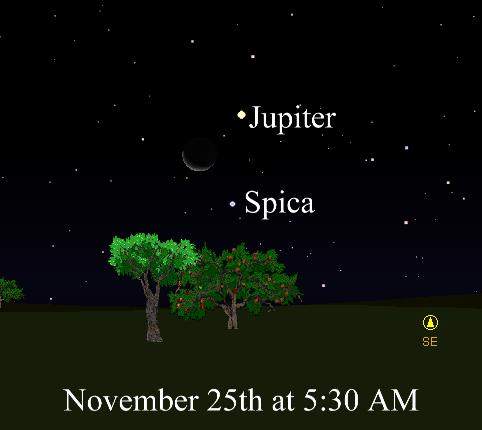
On the morning of the 25th, you’ll find the moon is sandwiched between Jupiter above and Spica below. The distance between upper Jupiter and lower Spica is too great for binoculars to see them at the same time. Spica by the way is the brightest star of Virgo the Maiden.


Your last chance to see earthsine in November is the morning of the 26th. 

The moon is new on the 29th, so don’t expect to see it in the evening again for a couple of days.

This Month’s Sources

Astronomical Phenomena of the Year 2016, The Nautical Almanac Office and Her Majesty’s Nautical Almanac Office
Astronomy Calendar of Celestial Events for Calendar Year 2016, http://www.seasky.org/astronomy/astronomy-calender-2016.html

Night Sky Explorer

Dark Skies and Bright Stars,

Your Interstellar Guide