PAUL
Welcome to Idaho Skies for the third week of March. We’re your hosts, Paul...
RACHEL
...and Rachel.
PAUL
The moon glides between Mars and the star Spica on the morning of the 19th.
RACHEL
The trio will almost close enough together to be seen at the same time through a pair or binoculars.
PAUL
How can you tell the difference between the Mars and Spica?
RACHEL
Mars is the much brighter orange-colored star to the upper right of the moon.
PAUL
And Spica, which is the brightest star of Virgo, is pure white and located a little farther away to the moon’s left
RACHEL
Spring begins at 11:57 AM on the 20th.
PAUL
This moment in time is called the Vernal Equinox and it’s the moment when the sun stands directly overhead Earth’s equator.
RACHEL
For the last six months, Earth’s southern hemisphere has faced directly towards the sun.
PAUL
That means it’s been spring and summer for our friends in Australia.
RACHEL
Now it’s the northern hemisphere’s chance to enjoy some light and heat from the sun.
PAUL
Want to find Saturn?
RACHEL
Let the moon help you out.
PAUL
Saturn and the moon appear close together on the morning of the 21st.
RACHEL
They actually crossed paths at 8:18 PM on the 20th when the moon occulted Saturn
PAUL
Unfortunately for Idaho, this occurred while they were above the Atlantic Ocean and below our horizon.
RACHEL
Venus reaches its greatest distance from the sun on the morning of the 22nd.
PAUL
However, morning appearances of Venus occurring during March take place at a time when the planet’s orbit is very shallow with respect to the northern hemisphere’s horizon.
RACHEL
So although Venus will appear 46 degrees away from the sun, it’s only seven degrees above the horizon at 5:30 AM.
PAUL
The moon reaches the third quarter phase on the 23rd.
RACHEL
Third quarter is a half full moon, but this time it’s the eastern half that’s in sunlight.
PAUL
Like the first quarter moon, this is an excellent phase for observing the moon
RACHEL
However, you’ll need to go outside after midnight to see the moon.
PAUL
Be sure to focus your attention on the terminator, or boundary between day and night.
RACHEL
Look closely and you may notice there are small points of light on the dark portion of the moon.
PAUL
These will be easier to see through a telescope.
RACHEL
If you do see them, you’ll be seeing high mountain tops or crater peaks where sunrise has occurred hours before it occurs at the surface below.
PAUL
That’s Idaho Skies for the third week of March. Next week you have an opportunity to photograph an attractive pairing of the moon and Venus.
RACHEL
Be sure to follow us on Twitter at Idaho Skies for this week’s event reminders and sky maps.
For Idaho Skies this is Rachel...
PAUL
...and Paul.
RACHEL
Dark skies and bright stars.
Sunday, March 16, 2014

Sunday, March 9, 2014
Transcript for March 9 - 15
RACHEL
Welcome to Idaho Skies for the second week of March. We’re your hosts, Rachel...
PAUL
...and Paul.
RACHEL
There’s a lunar occultation this week.
PAUL
The moon’s joining the occult?
RACHEL
No no, the moon’s covering up a star on the evening of the 10th.
PAUL
As the moon travels in its orbit around Earth, it occasionally passes between us and a star.
RACHEL
Astronomers call this event an occultation.
PAUL
The star is occulting a star in Gemini the Twins called Lambda Geminorum
RACHEL
The moon covers up Lambda along its dark edge.
PAUL
That’s along the right side of the moon.
RACHEL
Use your binoculars and scan along the bottom left of the moon shortly before 7:45 PM.
PAUL
You’ll want to identify Lambda Geminorum several minutes before it’s covered up by the dark edge of the moon.
RACHEL
The moon will cover up the star shortly after 8:00 PM.
PAUL
Because the occultation occurs on the dark edge of the moon, the star will disappear suddenly.
RACHEL
The reappearance of Lambda will be more difficult to observe.
PAUL
That’s because it occurs on the bright edge of the moon.
RACHEL
To observe it, watch the right side of the moon several minutes before 9:18 PM.
PAUL
Lambda reappears near the middle of the bright edge of the moon.
RACHEL
The moon is full on the 16th.
PAUL
The full moon is great for observing its lunar seas and maria.
RACHEL
However, it’s a bad for observing lunar craters and mountains.
PAUL
The one exception is the moon’s dark lunar craters.
RACHEL
These are old craters that became filled with lava.
PAUL
This only occurred in large craters that formed near the time of the moon’s birth.
RACHEL
That’s because craters younger than about 3.5 billion years were created after the moon’s core and mantle had cooled.
PAUL
As a result of the cooler lunar interior, there was no magma or liquid rock below the moon’s surface to fill the depressions created by the impacts.
RACHEL
Through binoculars, two dark craters are very prominent.
PAUL
Near the top of the moon is a 66 miles diameter crater named Plato.
RACHEL
And near the left edge of the moon is a dark crater named Grimaldi.
PAUL
Grimaldi is its 105 miles in diameter, a little bit more than the distance between Boise and Twin Falls.
RACHEL
That’s Idaho Skies for the second week of March. Next week is the first day of spring.
PAUL
Be sure to read our blog for additional information. It’s at idahoskies.blogspot.com. For Idaho Skies this is Paul...
RACHEL
...and Rachel.
PAUL
Dark skies and bright stars.
Welcome to Idaho Skies for the second week of March. We’re your hosts, Rachel...
PAUL
...and Paul.
RACHEL
There’s a lunar occultation this week.
PAUL
The moon’s joining the occult?
RACHEL
No no, the moon’s covering up a star on the evening of the 10th.
PAUL
As the moon travels in its orbit around Earth, it occasionally passes between us and a star.
RACHEL
Astronomers call this event an occultation.
PAUL
The star is occulting a star in Gemini the Twins called Lambda Geminorum
RACHEL
The moon covers up Lambda along its dark edge.
PAUL
That’s along the right side of the moon.
RACHEL
Use your binoculars and scan along the bottom left of the moon shortly before 7:45 PM.
PAUL
You’ll want to identify Lambda Geminorum several minutes before it’s covered up by the dark edge of the moon.
RACHEL
The moon will cover up the star shortly after 8:00 PM.
PAUL
Because the occultation occurs on the dark edge of the moon, the star will disappear suddenly.
RACHEL
The reappearance of Lambda will be more difficult to observe.
PAUL
That’s because it occurs on the bright edge of the moon.
RACHEL
To observe it, watch the right side of the moon several minutes before 9:18 PM.
PAUL
Lambda reappears near the middle of the bright edge of the moon.
RACHEL
The moon is full on the 16th.
PAUL
The full moon is great for observing its lunar seas and maria.
RACHEL
However, it’s a bad for observing lunar craters and mountains.
PAUL
The one exception is the moon’s dark lunar craters.
RACHEL
These are old craters that became filled with lava.
PAUL
This only occurred in large craters that formed near the time of the moon’s birth.
RACHEL
That’s because craters younger than about 3.5 billion years were created after the moon’s core and mantle had cooled.
PAUL
As a result of the cooler lunar interior, there was no magma or liquid rock below the moon’s surface to fill the depressions created by the impacts.
RACHEL
Through binoculars, two dark craters are very prominent.
PAUL
Near the top of the moon is a 66 miles diameter crater named Plato.
RACHEL
And near the left edge of the moon is a dark crater named Grimaldi.
PAUL
Grimaldi is its 105 miles in diameter, a little bit more than the distance between Boise and Twin Falls.
RACHEL
That’s Idaho Skies for the second week of March. Next week is the first day of spring.
PAUL
Be sure to read our blog for additional information. It’s at idahoskies.blogspot.com. For Idaho Skies this is Paul...
RACHEL
...and Rachel.
PAUL
Dark skies and bright stars.
Sunday, March 2, 2014
Transcript for March 2 - 8
PAUL
Welcome to Idaho Skies for the first week of March. We’re your hosts, Paul...
RACHEL
...and Rachel.
PAUL
This week, let’s talk about the visible planets for March.
RACHEL
Sure, have you seen a bright star above the eastern horizon in the morning as you drive to work?
PAUL
It’s Venus, the Morning Star.
RACHEL
If you haven’t seen it yet, then look for the Morning Star low in the east-southeast.
PAUL
The best time is between 5:30 and 6:00 AM.
RACHEL
If you point a telescope at Venus, you can see that it’s half full.
PAUL
It’s easier to see the phase of Venus if you wait until the sky is brightening.
RACHEL
That’s because Venus is so bright that its glare makes seeing any shape difficult.
PAUL
So wait until the middle of dawn, before the sun rises to observe Venus.
RACHEL
Mars is approaching opposition.
PAUL
Opposition occurs when a planet is opposite the sun in the sky from Earth’s perspective.
RACHEL
So during March, you can expect the planet to continue growing brighter.
PAUL
In fact, we can expect Mars to grow as bright as Sirius, the brightest star in the sky.
RACHEL
However, while Sirius is white, Mars will be noticeably orange-yellow in color.
PAUL
Mars rises at 10 PM by start of month and by sunset at end of month.
RACHEL
To see it, look for it in the east-southeast after dark.
PAUL
Jupiter is high in the south at the beginning of the month.
RACHEL
It’s getting slightly smaller and fainter this month.
PAUL
Why?
RACHEL
That’s because Earth travels much faster around the sun.
PAUL
Oh, so we’re pulling away from Jupiter then.
RACHEL
That’s right and you can’t miss Jupiter, it’s the brilliant yellow-white star high in the west.
PAUL
Saturn, the most distant planet you can see, is visible in the morning skies all during March.
PAUL
It rises after midnight at the beginning of the month and by 10:30 PM at the end of the month.
RACHEL
Look for Saturn low in the east-southeast.
PAUL
It’s the creamy white star and it doesn’t twinkle like the other stars.
RACHEL
For additional help locating it, Saturn is also the brightest star below orange-yellow Mars.
PAUL
That’s Idaho Skies for the first week of March. Next week, you can watch the moon cover up a star.
RACHEL
Be sure to follow us on Twitter at Idaho Skies for this week’s event reminders and sky maps.
For Idaho Skies this is Rachel...
PAUL
...and Paul.
RACHEL
Dark skies and bright stars.
Welcome to Idaho Skies for the first week of March. We’re your hosts, Paul...
RACHEL
...and Rachel.
PAUL
This week, let’s talk about the visible planets for March.
RACHEL
Sure, have you seen a bright star above the eastern horizon in the morning as you drive to work?
PAUL
It’s Venus, the Morning Star.
RACHEL
If you haven’t seen it yet, then look for the Morning Star low in the east-southeast.
PAUL
The best time is between 5:30 and 6:00 AM.
RACHEL
If you point a telescope at Venus, you can see that it’s half full.
PAUL
It’s easier to see the phase of Venus if you wait until the sky is brightening.
RACHEL
That’s because Venus is so bright that its glare makes seeing any shape difficult.
PAUL
So wait until the middle of dawn, before the sun rises to observe Venus.
RACHEL
Mars is approaching opposition.
PAUL
Opposition occurs when a planet is opposite the sun in the sky from Earth’s perspective.
RACHEL
So during March, you can expect the planet to continue growing brighter.
PAUL
In fact, we can expect Mars to grow as bright as Sirius, the brightest star in the sky.
RACHEL
However, while Sirius is white, Mars will be noticeably orange-yellow in color.
PAUL
Mars rises at 10 PM by start of month and by sunset at end of month.
RACHEL
To see it, look for it in the east-southeast after dark.
PAUL
Jupiter is high in the south at the beginning of the month.
RACHEL
It’s getting slightly smaller and fainter this month.
PAUL
Why?
RACHEL
That’s because Earth travels much faster around the sun.
PAUL
Oh, so we’re pulling away from Jupiter then.
RACHEL
That’s right and you can’t miss Jupiter, it’s the brilliant yellow-white star high in the west.
PAUL
Saturn, the most distant planet you can see, is visible in the morning skies all during March.
PAUL
It rises after midnight at the beginning of the month and by 10:30 PM at the end of the month.
RACHEL
Look for Saturn low in the east-southeast.
PAUL
It’s the creamy white star and it doesn’t twinkle like the other stars.
RACHEL
For additional help locating it, Saturn is also the brightest star below orange-yellow Mars.
PAUL
That’s Idaho Skies for the first week of March. Next week, you can watch the moon cover up a star.
RACHEL
Be sure to follow us on Twitter at Idaho Skies for this week’s event reminders and sky maps.
For Idaho Skies this is Rachel...
PAUL
...and Paul.
RACHEL
Dark skies and bright stars.
March's Constellation

Castor is an interesting star. Through a good telescope, it’s seen as two nearly identical stars with orbital periods of around 400 years. Currently, they are at their closest together with respect to Earth and the gap between them will widen over the coming decades. There’s a third much fainter companion to the south of the main pair that’s a red dwarf star called Castor C. Using spectroscopes, astronomers can detect the light of companion stars around all three stars. Therefore, Castor is reality three double stars in orbit around each other.
Gemini is nearly straight overhead by 8:30 PM at the beginning of March. Use binoculars or a small telescope to look for the galactic cluster M-35 in the right foot of Gemini. The galactic cluster appears as a small sprinkle of stars in binoculars and looks even better through a small telescope.
Sunday, February 16, 2014
Transcript for February 16-22
PAUL
Welcome to Idaho Skies for the third week of February. We’re your hosts, Paul…
RACHEL
…and Rachel.
PAUL
The 18th is the 84th anniversary of Clyde Tombaugh’s discovery of Pluto.
RACHEL
Clyde was a Kansas farm boy with an interest in astronomy.
PAUL
The astronomers at the Lowell Observatory in Flagstaff, Arizona were so impressed with his work that they invited him to join their staff.
RACHEL
His task was to take photographs of the sky in search of a 9th planet in our solar system.
PAUL
This required Clyde to take and search hundreds of photographs through the Observatory’s 13 inch telescope.
RACHEL
Each photograph contained thousands of star images and one of those stars could be the planet he was seeking.
PAUL
Clyde searched for the unknown planet by comparing two photographs of the same star field taken several days a part.
RACHEL
If the photographic plates contained an image of the 9th planet, the planet would shift in position while the stars remained stationary.
PAUL
On the 18th of February, he found one star that turned out to be Pluto.
RACHEL
Today astronomers have cataloged over a thousand Pluto-like bodies in the frozen depths of our solar system.
PAUL
The 19th is the 541st anniversary of Nicolas Copernicus' birth.
RACHEL
The public knows Copernicus for his model of a sun-centered solar system.
PAUL
Copernicus was not the first person to propose the heliocentric model.
RACHEL
That’s right, some ancient Greeks and Arabs had done the same centuries prior.
Copernicus was fortunate in proposing this model when many learned people were more willing to accept a sun centered solar system.
PAUL
On the 19th, Mars and the star Spica pose together with the moon.
RACHEL
Spica will be noticeably whiter in color and below the moon.
PAUL
Mars will have a more yellow color and appear to the moon’s left.
RACHEL
If you have the free time, go outside at 3:00 AM on the 21st.
PAUL
You’ll find the moon low in the southeast sandwiched between the star Zubenelgenubi and the planet Saturn.
RACHEL
Zubenelgenubi is the brightest star to the moon’s right and a pair of binoculars will show that this is a double star.
PAUL
Saturn is brighter and located farther away to the moon’s left.
RACHEL
And a small telescope will show Saturn’s rings and brightest satellite, Titan.
PAUL
Titan will appear three ring diameters away from Saturn to its lower left through your telescope.
RACHEL
That’s Idaho Skies for the third week of February. The moon forms an attractive grouping with Venus, the Morning Star next week.
PAUL
Be sure to follow us on Twitter at Idaho Skies for this week’s event reminders and sky maps.
For Idaho Skies this is Paul…
RACHEL
and Rachel.
PAUL
Dark skies and bright stars.
Welcome to Idaho Skies for the third week of February. We’re your hosts, Paul…
RACHEL
…and Rachel.
PAUL
The 18th is the 84th anniversary of Clyde Tombaugh’s discovery of Pluto.
RACHEL
Clyde was a Kansas farm boy with an interest in astronomy.
PAUL
The astronomers at the Lowell Observatory in Flagstaff, Arizona were so impressed with his work that they invited him to join their staff.
RACHEL
His task was to take photographs of the sky in search of a 9th planet in our solar system.
PAUL
This required Clyde to take and search hundreds of photographs through the Observatory’s 13 inch telescope.
RACHEL
Each photograph contained thousands of star images and one of those stars could be the planet he was seeking.
PAUL
Clyde searched for the unknown planet by comparing two photographs of the same star field taken several days a part.
RACHEL
If the photographic plates contained an image of the 9th planet, the planet would shift in position while the stars remained stationary.
PAUL
On the 18th of February, he found one star that turned out to be Pluto.
RACHEL
Today astronomers have cataloged over a thousand Pluto-like bodies in the frozen depths of our solar system.
PAUL
The 19th is the 541st anniversary of Nicolas Copernicus' birth.
RACHEL
The public knows Copernicus for his model of a sun-centered solar system.
PAUL
Copernicus was not the first person to propose the heliocentric model.
RACHEL
That’s right, some ancient Greeks and Arabs had done the same centuries prior.
Copernicus was fortunate in proposing this model when many learned people were more willing to accept a sun centered solar system.
PAUL
On the 19th, Mars and the star Spica pose together with the moon.
RACHEL
Spica will be noticeably whiter in color and below the moon.
PAUL
Mars will have a more yellow color and appear to the moon’s left.
RACHEL
If you have the free time, go outside at 3:00 AM on the 21st.
PAUL
You’ll find the moon low in the southeast sandwiched between the star Zubenelgenubi and the planet Saturn.
RACHEL
Zubenelgenubi is the brightest star to the moon’s right and a pair of binoculars will show that this is a double star.
PAUL
Saturn is brighter and located farther away to the moon’s left.
RACHEL
And a small telescope will show Saturn’s rings and brightest satellite, Titan.
PAUL
Titan will appear three ring diameters away from Saturn to its lower left through your telescope.
RACHEL
That’s Idaho Skies for the third week of February. The moon forms an attractive grouping with Venus, the Morning Star next week.
PAUL
Be sure to follow us on Twitter at Idaho Skies for this week’s event reminders and sky maps.
For Idaho Skies this is Paul…
RACHEL
and Rachel.
PAUL
Dark skies and bright stars.
Sunday, February 2, 2014
Transcript for February 2 - 8
PAUL
Welcome to Idaho Skies for the first week of February. We’re your hosts, Paul…
RACHEL
… and Rachel.
PAUL
Do you own a telescope with quality optics, a sharp focus, and steady stand?
RACHEL
Then you should be able to use it to observe the shadows cast by Jupiter’s satellites.
PAUL
Your opportunity this month begins early on the morning of the 6th.
RACHEL
The shadow of Callisto, Jupiter’s second largest satellite appears at 1:25 AM near the bottom of Jupiter.
PAUL
It appears at the bottom of Jupiter because telescopes invert images.
RACHEL
You’ll be able to watch the shadow drift across the face of Jupiter until 4:30 AM.
PAUL
Jupiter is the bright star high in the west at 1:30 AM.
RACHEL
An event easier to observe event involving Earth’s moon takes place on the evening of the 6th.
PAUL
That’s when the moon passes the Pleiades star cluster.
RACHEL
The moon then passes the Hyades star cluster the next night.
PAUL
Get you binoculars out for the 7th, since the moon will be just edging into the Hyades.
RACHEL
Novelist Jules Verne was born 186 years ago on the 8th.
PAUL
He’s considered one of the fathers of the science fiction genre.
RACHEL
Jules Verne is probably the third most translated author in the world.
PAUL
Many of the elements from his story, From the Earth to the Moon match those in the Apollo 11 mission to the moon.
RACHEL
For example, in Verne’s novel and Apollo 11, the United States launched the first manned vehicle to the moon.
PAUL
Verne’s spacecraft closely resemble the Apollo 11 spacecraft in size and shape.
RACHEL
Both spacecraft carried a crew of three.
PAUL
Both Verne’s spacecraft and Apollo 11 were launched from Florida.
RACHEL
Both spacecraft returned to Earth by splashing down in the Pacific Ocean.
PAUL
Now there were a few problems with Verne’s depiction.
RACHEL
First off, Verne’s spacecraft was launched using a giant cannon.
PAUL
A cannon capable of propelling a spacecraft to the moon would crush and flatten its crew.
RACHEL
The second problem in Verne’s story is that he thought his astronauts would only experience weightlessness at the gravitational midpoint between the moon and Earth.
PAUL
That’s where the gravities of Earth and the moon would be equal and opposite in direction.
RACHEL
In reality, the Apollo 11 astronauts experience weightlessness the entire journey because they are traveling just as fast as the spacecraft.
PAUL
Still, Verne’s story, From the Earth to the Moon is a reasonable science fiction for the middle of the 19th century.
PAUL
That’s Idaho Skies for the first week of February. Next week, the moon helps you locate a very nice star cluster using your binoculars.
RACHEL
Be sure to follow us on Twitter at Idaho Skies for this week’s event reminders and sky maps.
For Idaho Skies this is Rachel…
PAUL
and Paul.
RACHEL
Dark skies and bright stars.
Welcome to Idaho Skies for the first week of February. We’re your hosts, Paul…
RACHEL
… and Rachel.
PAUL
Do you own a telescope with quality optics, a sharp focus, and steady stand?
RACHEL
Then you should be able to use it to observe the shadows cast by Jupiter’s satellites.
PAUL
Your opportunity this month begins early on the morning of the 6th.
RACHEL
The shadow of Callisto, Jupiter’s second largest satellite appears at 1:25 AM near the bottom of Jupiter.
PAUL
It appears at the bottom of Jupiter because telescopes invert images.
RACHEL
You’ll be able to watch the shadow drift across the face of Jupiter until 4:30 AM.
PAUL
Jupiter is the bright star high in the west at 1:30 AM.
RACHEL
An event easier to observe event involving Earth’s moon takes place on the evening of the 6th.
PAUL
That’s when the moon passes the Pleiades star cluster.
RACHEL
The moon then passes the Hyades star cluster the next night.
PAUL
Get you binoculars out for the 7th, since the moon will be just edging into the Hyades.
RACHEL
Novelist Jules Verne was born 186 years ago on the 8th.
PAUL
He’s considered one of the fathers of the science fiction genre.
RACHEL
Jules Verne is probably the third most translated author in the world.
PAUL
Many of the elements from his story, From the Earth to the Moon match those in the Apollo 11 mission to the moon.
RACHEL
For example, in Verne’s novel and Apollo 11, the United States launched the first manned vehicle to the moon.
PAUL
Verne’s spacecraft closely resemble the Apollo 11 spacecraft in size and shape.
RACHEL
Both spacecraft carried a crew of three.
PAUL
Both Verne’s spacecraft and Apollo 11 were launched from Florida.
RACHEL
Both spacecraft returned to Earth by splashing down in the Pacific Ocean.
PAUL
Now there were a few problems with Verne’s depiction.
RACHEL
First off, Verne’s spacecraft was launched using a giant cannon.
PAUL
A cannon capable of propelling a spacecraft to the moon would crush and flatten its crew.
RACHEL
The second problem in Verne’s story is that he thought his astronauts would only experience weightlessness at the gravitational midpoint between the moon and Earth.
PAUL
That’s where the gravities of Earth and the moon would be equal and opposite in direction.
RACHEL
In reality, the Apollo 11 astronauts experience weightlessness the entire journey because they are traveling just as fast as the spacecraft.
PAUL
Still, Verne’s story, From the Earth to the Moon is a reasonable science fiction for the middle of the 19th century.
PAUL
That’s Idaho Skies for the first week of February. Next week, the moon helps you locate a very nice star cluster using your binoculars.
RACHEL
Be sure to follow us on Twitter at Idaho Skies for this week’s event reminders and sky maps.
For Idaho Skies this is Rachel…
PAUL
and Paul.
RACHEL
Dark skies and bright stars.
February's Star
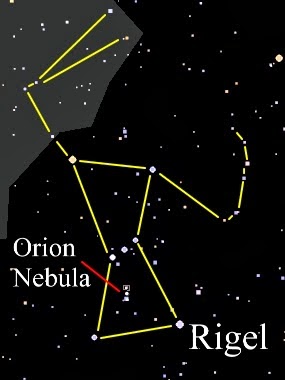
This month look for the star, Rigel, the bright white star in the lower right corner of the constellation of Orion the Hunter. Rigel’s name comes from the Arabic, ar-Rijl, which means “the foot”. Astronomers know Rigel as Beta Orionis, indicating that it is the second brightest star in Orion. Actually though, Betelgeuse, the red-orange star in Orion is slightly fainter than Rigel, making Rigel the brightest star in Orion. Overall, Rigel is the 7th brightest star in our skies. It’s a blue supergiant star, 17 times more massive than our Sun, 70 times larger, and 40,000 times brighter. At a distance of 777 light years, the light that you see tonight left Rigel in 1237.
Orion is due south at 9:30 PM in the beginning of February, making it well placed for observing. While looking for Rigel, take a moment to look at the middle star in Orion’s sword. This is the famous Orion Nebula, a great stellar nursery. Here, hundreds of stars are being born within a swirling cloud of dust and gas. Images taken with the Hubble Space Telescope show that many of these stars are surrounded in a disk of dust and gas. Perhaps in some 4 billion years, an intelligence on a planet around one of these stars will look up their night sky and wonder about the possibility of life around the stars visible in the night sky. By then, unfortunately, our Sun will be a white dwarf star and slowly cooling down after having incinerated some of its planets, possibility even one called Earth.
Subscribe to:
Posts (Atom)