Sunday, March 2, 2014

March's Constellation

This month look for the stars Castor and Pollux, the two brightest stars in Gemini the Twins. Since Castor (Alpha Geminorum) is a little fainter than Pollux (Beta Geminorum), Gemini is one of the few constellations in which the brightest star is not its alpha star. Caster is 52 light-years away and Pollux is 34 light-years away. If you were born in 1962 Castor is your birthday star this year and if you were born in 1980 Pollux is your birthday star this year.

Castor is an interesting star. Through a good telescope, it’s seen as two nearly identical stars with orbital periods of around 400 years. Currently, they are at their closest together with respect to Earth and the gap between them will widen over the coming decades. There’s a third much fainter companion to the south of the main pair that’s a red dwarf star called Castor C. Using spectroscopes, astronomers can detect the light of companion stars around all three stars. Therefore, Castor is reality three double stars in orbit around each other.

Gemini is nearly straight overhead by 8:30 PM at the beginning of March. Use binoculars or a small telescope to look for the galactic cluster M-35 in the right foot of Gemini. The galactic cluster appears as a small sprinkle of stars in binoculars and looks even better through a small telescope.    

Sunday, February 16, 2014

Transcript for February 16-22

PAUL
Welcome to Idaho Skies for the third week of February. We’re your hosts, Paul…

RACHEL
…and Rachel.

PAUL
The 18th is the 84th anniversary of Clyde Tombaugh’s discovery of Pluto.

RACHEL
Clyde was a Kansas farm boy with an interest in astronomy.

PAUL
The astronomers at the Lowell Observatory in Flagstaff, Arizona were so impressed with his work that they invited him to join their staff.

RACHEL
His task was to take photographs of the sky in search of a 9th planet in our solar system.

PAUL
This required Clyde to take and search hundreds of photographs through the Observatory’s 13 inch telescope.

RACHEL
Each photograph contained thousands of star images and one of those stars could be the planet he was seeking.

PAUL
Clyde searched for the unknown planet by comparing two photographs of the same star field taken several days a part.

RACHEL
If the photographic plates contained an image of the 9th planet, the planet would shift in position while the stars remained stationary.

PAUL
On the 18th of February, he found one star that turned out to be Pluto.

RACHEL
Today astronomers have cataloged over a thousand Pluto-like bodies in the frozen depths of our solar system.

PAUL
The 19th is the 541st anniversary of Nicolas Copernicus' birth.

RACHEL
The public knows Copernicus for his model of a sun-centered solar system.

PAUL
Copernicus was not the first person to propose the heliocentric model.

RACHEL
That’s right, some ancient Greeks and Arabs had done the same centuries prior.
Copernicus was fortunate in proposing this model when many learned people were more willing to accept a sun centered solar system.

PAUL
On the 19th, Mars and the star Spica pose together with the moon.

RACHEL
Spica will be noticeably whiter in color and below the moon.

PAUL
Mars will have a more yellow color and appear to the moon’s left.

RACHEL
If you have the free time, go outside at 3:00 AM on the 21st.

PAUL
You’ll find the moon low in the southeast sandwiched between the star Zubenelgenubi and the planet Saturn.

RACHEL
Zubenelgenubi is the brightest star to the moon’s right and a pair of binoculars will show that this is a double star.

PAUL
Saturn is brighter and located farther away to the moon’s left.

RACHEL
And a small telescope will show Saturn’s rings and brightest satellite, Titan.

PAUL
Titan will appear three ring diameters away from Saturn to its lower left through your telescope.

RACHEL
That’s Idaho Skies for the third week of February. The moon forms an attractive grouping with Venus, the Morning Star next week. 

PAUL
Be sure to follow us on Twitter at Idaho Skies for this week’s event reminders and sky maps.

For Idaho Skies this is Paul…

RACHEL
and Rachel.

PAUL
Dark skies and bright stars.

Sunday, February 2, 2014

Transcript for February 2 - 8

PAUL
Welcome to Idaho Skies for the first week of February. We’re your hosts, Paul…

RACHEL
… and Rachel.

PAUL
Do you own a telescope with quality optics, a sharp focus, and steady stand?

RACHEL
Then you should be able to use it to observe the shadows cast by Jupiter’s satellites.

PAUL
Your opportunity this month begins early on the morning of the 6th.

RACHEL
The shadow of Callisto, Jupiter’s second largest satellite appears at 1:25 AM near the bottom of Jupiter.

PAUL
It appears at the bottom of Jupiter because telescopes invert images.

RACHEL
You’ll be able to watch the shadow drift across the face of Jupiter until 4:30 AM.

PAUL
Jupiter is the bright star high in the west at 1:30 AM.

RACHEL
An event easier to observe event involving Earth’s moon takes place on the evening of the 6th.

PAUL
That’s when the moon passes the Pleiades star cluster.

RACHEL
The moon then passes the Hyades star cluster the next night.

PAUL
Get you binoculars out for the 7th, since the moon will be just edging into the Hyades.

RACHEL
Novelist Jules Verne was born 186 years ago on the 8th.

PAUL
He’s considered one of the fathers of the science fiction genre.

RACHEL
Jules Verne is probably the third most translated author in the world.

PAUL
Many of the elements from his story, From the Earth to the Moon match those in the Apollo 11 mission to the moon.

RACHEL
For example, in Verne’s novel and Apollo 11, the United States launched the first manned vehicle to the moon.

PAUL
Verne’s spacecraft closely resemble the Apollo 11 spacecraft in size and shape.

RACHEL
Both spacecraft carried a crew of three.

PAUL
Both Verne’s spacecraft and Apollo 11 were launched from Florida.

RACHEL
Both spacecraft returned to Earth by splashing down in the Pacific Ocean.

PAUL
Now there were a few problems with Verne’s depiction.

RACHEL
First off, Verne’s spacecraft was launched using a giant cannon.

PAUL
A cannon capable of propelling a spacecraft to the moon would crush and flatten its crew.

RACHEL
The second problem in Verne’s story is that he thought his astronauts would only experience weightlessness at the gravitational midpoint between the moon and Earth.

PAUL
That’s where the gravities of Earth and the moon would be equal and opposite in direction.

RACHEL
In reality, the Apollo 11 astronauts experience weightlessness the entire journey because they are traveling just as fast as the spacecraft.

PAUL
Still, Verne’s story, From the Earth to the Moon is a reasonable science fiction for the middle of the 19th century.

PAUL
That’s Idaho Skies for the first week of February. Next week, the moon helps you locate a very nice star cluster using your binoculars.

RACHEL
Be sure to follow us on Twitter at Idaho Skies for this week’s event reminders and sky maps.

For Idaho Skies this is Rachel…

PAUL
and Paul.

RACHEL
Dark skies and bright stars.

February's Star


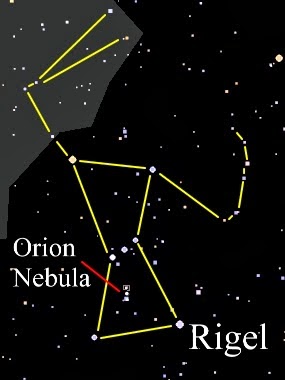
This month look for the star, Rigel, the bright white star in the lower right corner of the constellation of Orion the Hunter. Rigel’s name comes from the Arabic, ar-Rijl, which means “the foot”. Astronomers know Rigel as Beta Orionis, indicating that it is the second brightest star in Orion. Actually though, Betelgeuse, the red-orange star in Orion is slightly fainter than Rigel, making Rigel the brightest star in Orion. Overall, Rigel is the 7th brightest star in our skies. It’s a blue supergiant star, 17 times more massive than our Sun, 70 times larger, and 40,000 times brighter. At a distance of 777 light years, the light that you see tonight left Rigel in 1237.

Orion is due south at 9:30 PM in the beginning of February, making it well placed for observing. While looking for Rigel, take a moment to look at the middle star in Orion’s sword. This is the famous Orion Nebula, a great stellar nursery. Here, hundreds of stars are being born within a swirling cloud of dust and gas. Images taken with the Hubble Space Telescope show that many of these stars are surrounded in a disk of dust and gas. Perhaps in some 4 billion years, an intelligence on a planet around one of these stars will look up their night sky and wonder about the possibility of life around the stars visible in the night sky. By then, unfortunately, our Sun will be a white dwarf star and slowly cooling down after having incinerated some of its planets, possibility even one called Earth.       

Saturday, January 25, 2014

Transcript for the Last week of January

PAUL
Welcome to Idaho Skies for the last week of January. We’re your hosts, Paul…

RACHEL
…and Rachel.

PAUL
If you’re out and about at 6:40 AM on Sunday, January 26th, then look for the thin crescent moon in the low southeast.

RACHEL
The moon will be above the star Antares, one of the largest stars in our galaxy.

PAUL
If this star replaced our sun, it would engulf all the inner planets out to Mars.

RACHEL
This is funny in a way, since the star’s name means rival of Mars.

PAUL
Antares is a red giant star and the heart of the constellation of Scorpius, the Scorpion.

RACHEL
Time for planet watching this week.

PAUL
Innermost Mercury reaches its greatest distance from the sun on the 31st.

RACHEL
Astronomers call this event its greatest eastern elongation.

PAUL
Although Mercury is 18 degrees away from the sun, a line between Mercury and the sun tilts strongly relative to the horizon.

RACHEL
This means Mercury only appears 9 degrees above the horizon.

PAUL
If you want to see this tiny planet, then go outside at 6:30 PM and look low in the west-southwest.

RACHEL
Mercury will be the only star visible near the horizon.

PAUL
For a second treat, search to the right of Mercury with your binoculars.

RACHEL
Less than a binocular’s field of view away, you will spy the one day old moon.

PAUL
It will appear as an incredibly thin crescent, if your can locate it.

RACHEL
United States entered the Space Age 56 years ago on the 31st.

PAUL
That’s when the Jet Propulsion Laboratory in Pasadena and the US Army lofted the satellite Explorer 1 into orbit.

RACHEL
The rocket was the four stage Juno 1 rocket, which was a modification of von Braun’s Redstone missile.

PAUL
Explorer 1 weighed 31 pounds and was 81 inches long and 7 inches in diameter.

RACHEL
Its experiments included Geiger counters to measure radiation, a microphone to listen to micrometeoroid strikes, a temperature gauge to determined how the sun’s light affected the satellite, and radio.

PAUL
Explorer 1 was the third spacecraft into Earth orbit.

RACHEL
The other two were the Soviet Sputnik 1 and Sputnik 2.

PAUL
However, unlike the Sputniks, Explorer 1 made the first discovery of the Space Age.

RACHEL
It was the existence of a belt of radiation surrounding Earth.

PAUL
Since physicist James van Allen built the Geiger counters responsible for this discovery, we call the belts the Van Allen belts.

RACHEL
Explorer 1 remained in orbit until 1972 when air friction finally brought it back to Earth.

PAUL
That’s Idaho Skies for the last of January. Join us next month for the space and astronomy events for Idaho.

RACHEL
Be sure to follow us on Twitter at Idaho Skies for this week’s event reminders and sky maps.

For Idaho Skies this is Rachel…

PAUL
and Paul.

RACHEL
Dark skies and bright stars.

Monday, January 20, 2014

Transcript for Feb 19 - 25

RACHEL
Welcome to Idaho Skies for the fourth week of January. We’re your hosts, Rachel…

PAUL
…and Paul.

RACHEL
The gibbous moon is due south at 3:45 AM on the morning of the 20th.

PAUL
If you have some free time and a pair of binoculars or small telescope, you can watch the moon cover a 7th magnitude star named Hipparcos 54260.

RACHEL
Magnitude 7 stars are fainter than we can see with our unaided eye, but easily bright enough to see in binoculars or a small telescope.

PAUL
The star will disappear on the bright side of the moon, or to our east just after 3:45 AM.

RACHEL
Happy birthday Buzz!

PAUL
Buzz Aldrin is 84 years young on the 20th.

RACHEL
Buzz was the second man to set foot on the Moon when Apollo 11 landed on July 20, 1969.

PAUL
English mathematician John Couch Adams was born 224 years ago on the 21st.

RACHEL
Why is Adams important to the history of astronomy?

PAUL
Well, after the 1781 accidental discovery of Uranus by William Hershel, astronomers noticed that the planet wasn’t orbiting the sun as Newton’s Laws predicted.

RACHEL
That gave astronomers two choices.

PAUL
Either Newton’s Laws failed at large distances from the sun or that an unseen planet was tugging on Uranus.

RACHEL
Adams assumed the latter and began calculating the position of this unknown planet beyond Uranus.

PAUL
Unfortunately, before Adams could convince English astronomers to search in his calculated position, French mathematicians and astronomers did the same thing.

RACHEL
Their calculated position was nearly identical to Adam’s and they found Neptune after less than an hour of searching.

PAUL
The Italians get the last laugh however.

RACHEL
That’s right. We have since learned that Galileo recorded Neptune in his notes about Jupiter’s moons, not realizing that the “star” near Jupiter was actually Neptune.

PAUL
As the moon rises on January 23rd, you’ll see the star Spica located just to its right.

RACHEL
The moon just missed covering Spica before it rose over Boise.

PAUL
Spica is the brightest star of the large and faint constellation, Virgo.

RACHEL
The constellation represents Demeter, the goddess of the harvest.

PAUL
And Spica represents a sheaf of wheat that she’s holding in her hand.

RACHEL
Spica is 260 light years away. So the light you see tonight left in 1754 or at the beginning of the French and Indian War.

PAUL
Look for Spica to the right of the rising moon just after it rises at 12:30 AM.

RACHEL
The planet Mars a little above the moon.

PAUL
Mars appears about as bright as Spica, but it has a noticeable yellow-orange tint.

PAUL
That’s Idaho Skies for the fourth week of January. Next week tiny innermost Mercury makes its last appearance for the year.

RACHEL
Be sure to read our blog for additional information. It’s at idahoskies dot blogspot dot com For Idaho Skies this is Rachel…

PAUL
and Paul.

RACHEL
Dark skies and bright stars.

Saturday, January 4, 2014

Transcript for Jan 5 - 11

RACHEL
Welcome to Idaho Skies for the second week of January. We’re your hosts, Rachel…

PAUL
…and Paul.

RACHEL
Earth reaches perihelion on January 4th.

PAUL
As many people know, Earth’s orbit around the sun is not perfectly circular.

RACHEL
It follows a mathematically-precise oval shape called an ellipse.

PAUL
Because of Earth’s elliptical orbit, we’re 3 million miles closer to the sun on January 4th than in July.

RACHEL
The laws of gravity dictate that Earth’s orbital speed around the sun will also be at its greatest today.

PAUL
This means winter in the northern hemisphere is several days shorter than its summer.

RACHEL
Mighty Jupiter reaches opposition on the 5th.

PAUL
Opposition is a point in space opposite the sun, that is, relative from our perspective.

RACHEL
At opposition, a planet beyond Earth is its closest to us.

PAUL
This makes the planet its largest and brightest in our sky.

RACHEL
Speaking of Jupiter, one of astronomy’s most momentous events occurred 404 years ago starting on the 7th.

PAUL
In 1610, Galileo Galilei turned his new telescope towards Jupiter and discovered that four large moons circled the planet.

RACHEL
Up until this time, most learned people believed that all heavenly bodies orbited around the Earth.

PAUL
This view of the world is called the geocentric model.

RACHEL
The geocentric model made sense because no one figure out how moons can remain in orbit around a planet while the planet is orbiting the sun.

PAUL
It also helped that no one felt Earth move or spin.

RACHEL
Galileo’s observations of the four large moons orbiting Jupiter showed that it was indeed possible to have more than one center of motion in the universe.

PAUL
That observation, along with his later observation of the phases of Venus cleared the way for astronomers to accept a new model for the solar system.

RACHEL
Nicholas Copernicus advocated this new model and it placed the sun at the center of the solar system.

PAUL
Although Copernicus did have some competition.

RACHEL
That’s right. Astronomer Tycho Brahe argued for a model that combined both the geocentric and heliocentric models.

PAUL
His mixed model had two benefits. First, it still left Earth stationary at the center of the solar system.

RACHEL
And second, it didn’t require the stars to be fantastically far away.

PAUL
You can see the Galileo’s Jovian satellites yourself with a pair of binoculars.

RACHEL
You’ll need to hold the binoculars steady against something, like a tree.

PAUL
Jupiter rises in the east-northeast at 6:00 PM this week.

RACHEL
You can’t miss it; Jupiter will be the brightest star in the sky.

PAUL
Happy birthday Stephen Hawking.

RACHEL
He celebrates his 74th birthday on the 8th.

RACHEL
That’s Idaho Skies for the second week of January. Next week is the birthday of the man most responsible for the Space Race of the 1960s. 

PAUL
Be sure to read our blog for additional information. It’s at idahoskies.blogspot.com. For Idaho Skies this is Paul…

RACHEL
...and Rachel.

PAUL
Dark skies and bright stars.